Table of Contents
AprilAire E80W, E100W, or E130W: Which One Belongs in Your Crawl Space?
By late May in the Triangle, vented crawl spaces are already picking up outdoor humidity as the dew point climbs. That’s when homeowners who’ve been putting off a dehumidifier decision start searching seriously, and that’s where the question of which AprilAire unit to install comes up.
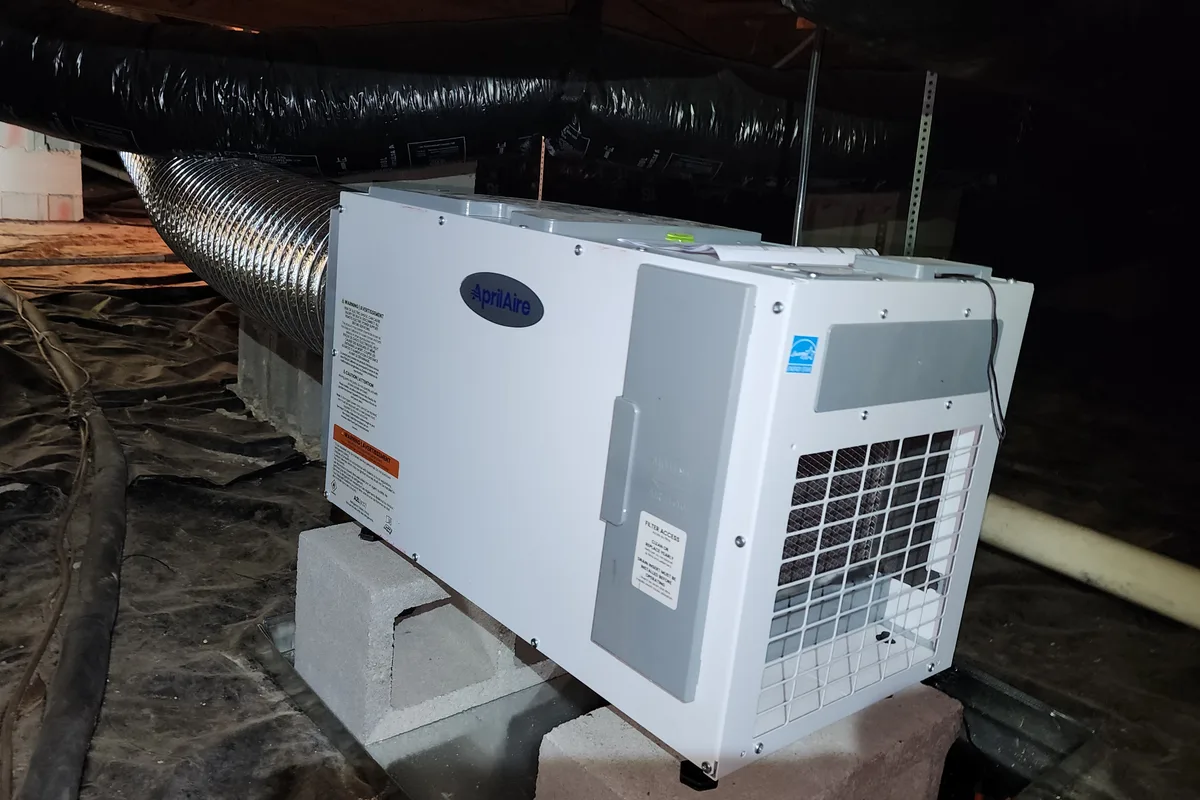
Triangle Dehumidifiers, LLC installs three AprilAire WiFi dehumidifier models in crawl spaces across Wake County: the E80W, E100W, and E130W. The right choice depends on your crawl space type (vented or encapsulated), square footage, and current moisture conditions. The short answer: most vented crawl spaces in the Triangle need the E100W or E130W, not the E80W.
What the Three Models Do
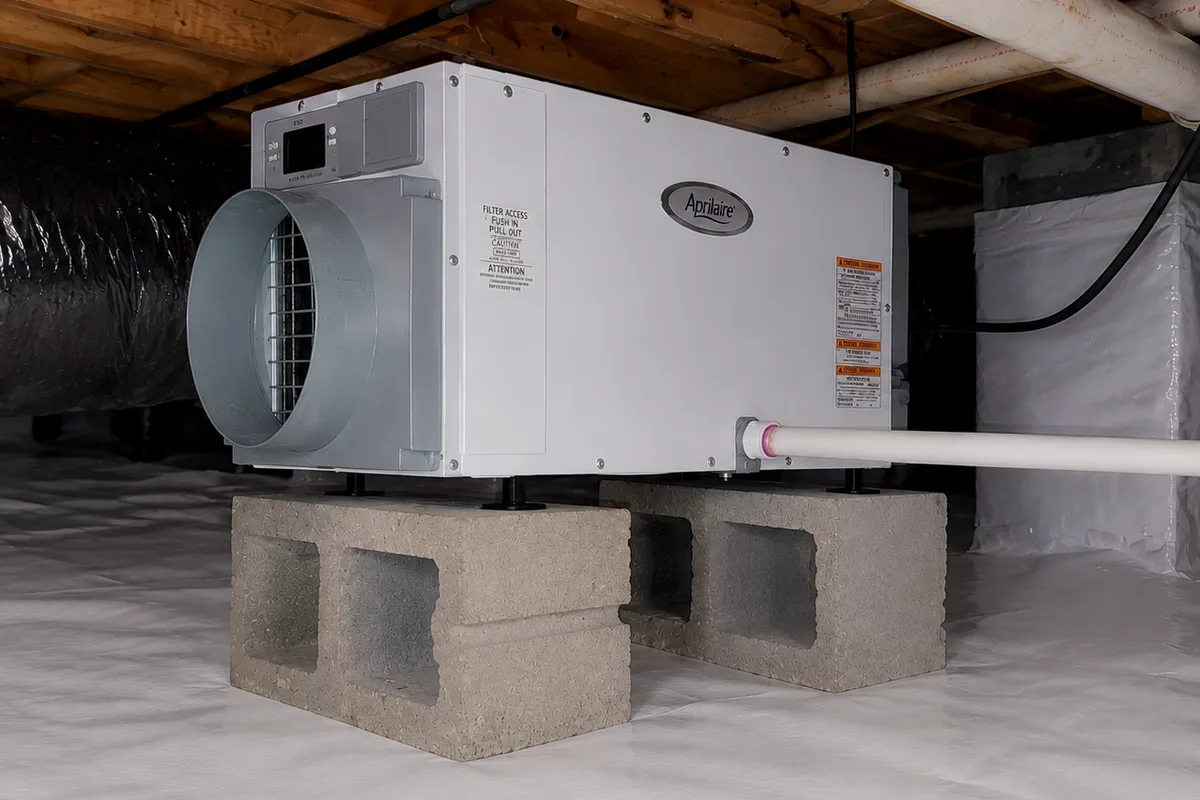
All three are self-draining, WiFi-connected units that mount on blocks inside the crawl space and route condensate to the exterior via a pump line. The difference is capacity: how many pints of moisture each unit can remove per day under standard conditions.
The capacity numbers are measured at AHAM conditions (80°F, 60% RH), roughly what a conditioned interior feels like. A vented crawl space in August in the Triangle commonly runs 75–85% RH, which means the unit works harder and its effective output is somewhat lower than the rated number.
Why the E80W Is Usually the Wrong Choice for a Vented Crawl Space
The E80W is designed for a sealed, encapsulated crawl space that already has a vapor barrier and closed foundation vents. In that setting, the unit’s job is residual moisture control: dealing with vapor that seeps through concrete and the floor assembly. An encapsulated crawl space is not constantly replenished with humid outdoor air.
A vented crawl space in the Triangle is. During summer, outdoor air at 70–85% RH flows freely through the foundation vents. That’s a continuous moisture source, not a residual one. The E80W running flat-out can keep pace in a small space, under 800–1,000 square feet in mild conditions, but in a typical 1,200–2,000 square foot vented crawl space, it will run continuously through July and August and still struggle to hold 55% RH.
The E100W: The Most Common Fit for Triangle Crawl Spaces
For most Triangle homes with a vented crawl space in the 1,000–1,500 square foot range, the AprilAire E100W is the right unit. At 100 pints per day, it has enough capacity to handle summer humidity in a typical vented crawl space without running at 100% duty cycle all the time.
It also works well in larger encapsulated spaces. If your crawl space is 1,500–2,500 square feet and fully sealed, the E100W is typically the right fit there too.
Some situations where the E100W is the standard recommendation:
- Vented crawl space, 1,000–1,500 sq ft, average Triangle humidity conditions
- Encapsulated crawl space, 1,500–2,500 sq ft
- Homes in Cary, Apex, or Holly Springs with a standard single-story footprint
For most Wake County homes built between the 1990s and 2010s, the E100W is what Triangle Dehumidifiers installs.
The E130W: When You Need More Capacity
The E130W is rated to cover homes up to 7,200 square feet in whole-house applications, but for crawl space use the relevant question is whether the moisture load exceeds what the E100W can handle. That happens when:
- The vented crawl space is over 1,500 square feet
- The crawl space ceiling is taller than 3 feet (more air volume, higher moisture mass)
- Conditions are persistently high: 80%+ RH even after the vents have been closed
- The home sits on Piedmont clay soil with poor drainage, holding groundwater against the foundation
Homes in parts of Garner, Fuquay-Varina, and older Raleigh neighborhoods near the Neuse River basin often fall into this category. Clay drains slowly, and those crawl spaces stay wetter even in dry spells. For those situations, the E130W is the safer choice.
How Triangle Dehumidifiers Decides Which Unit to Install
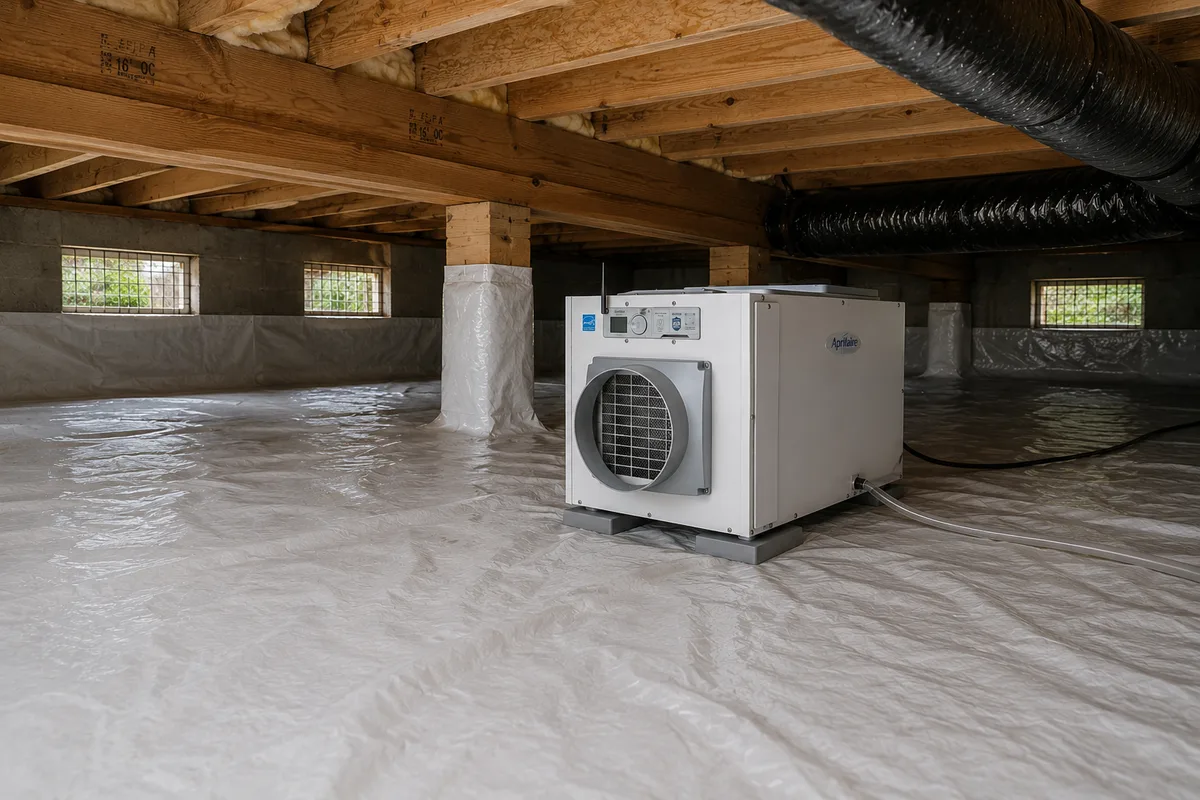
Before recommending a model, Triangle Dehumidifiers, LLC measures the crawl space and checks current humidity and temperature. The variables that drive the decision:
- Crawl space type: vented or encapsulated (or partially sealed)
- Square footage and ceiling height: both affect air volume and total moisture load
- Current humidity readings: a crawl space already at 80% RH needs more capacity than one at 65%
- Drainage: condensate needs a clear path to the exterior
- Vents: on a vented crawl space install, the vents are typically closed as part of the job to limit the continuous outdoor air infiltration the unit has to process
No model recommendation is final without a site visit. A 1,100 sq ft ranch in Holly Springs may need a different unit than a 1,800 sq ft two-story in Garner with a taller crawl space and worse drainage. See the full crawl space dehumidifier service page for an overview of how Triangle Dehumidifiers approaches these installs across Wake County.
For homeowners working through the decision, the full crawl space dehumidifier sizing guide covers how square footage, crawl type, and moisture load interact before you land on a specific model.
What Does Installation Cost in the Triangle?
Installed pricing from Triangle Dehumidifiers in Wake County:
- Encapsulated crawl space: an estimated $3,000–$4,000, typically with the E80W or E100W
- Vented crawl space (vents closed as part of install): an estimated $3,000–$5,000, typically with the E100W or E130W
The range reflects crawl space size, how far the condensate line needs to run, whether a pump is needed, and which unit fits the space. A free inspection produces an exact quote. For a breakdown of what drives the price, the crawl space dehumidifier cost guide for Raleigh covers the variables.
Frequently Asked Questions
What is the difference between the AprilAire E80W, E100W, and E130W?
The E80W removes 80 pints of moisture per day and works best in encapsulated crawl spaces. The E100W removes 100 pints per day and handles smaller vented crawl spaces or larger encapsulated ones. The E130W removes 130 pints per day and is designed for larger vented crawl spaces, taller crawl spaces, or high-moisture conditions. All three have built-in WiFi and connect to the AprilAire app.
Which AprilAire dehumidifier is best for a vented crawl space in North Carolina?
For a vented crawl space in the Triangle, the E100W or E130W is typically the right choice. Vented crawl spaces in NC reach 70–85% relative humidity in summer, which creates a higher moisture load than a sealed space. The E130W is the better fit for crawl spaces over 1,500 square feet or those with persistently high humidity.
Can the AprilAire E80W handle a vented crawl space?
The E80W can work in a vented crawl space if the space is small and conditions are not severe, but it will run more continuously and may fall short during peak summer humidity. Triangle Dehumidifiers recommends the E100W or E130W for most vented crawl spaces in Wake County.
How much does it cost to have an AprilAire crawl space dehumidifier installed in the Triangle?
Installed cost in the Triangle typically runs $3,000–$4,000 for an encapsulated crawl space and $3,000–$5,000 for a vented crawl space where the vents are closed as part of the installation. Exact cost depends on crawl space size, drainage requirements, and the unit selected.
Get the Right Unit Installed Before Peak Humidity Season
By July, vented crawl spaces in the Triangle are at their worst. 80%+ RH is common, and that’s the level where mold growth on floor joists begins within weeks. Getting the right-sized dehumidifier in place now means entering summer with humidity under control rather than chasing it.
Triangle Dehumidifiers, LLC provides free crawl space inspections throughout Wake County and the Triangle. We’ll measure your crawl space, check current humidity levels, and tell you exactly which AprilAire unit fits your situation, with an exact installed price.
Call or text us at (919) 867-0580, or request your inspection online. We serve Raleigh, Cary, Apex, Holly Springs, Fuquay-Varina, Garner, Wake Forest, Knightdale, Morrisville, Durham, and Chapel Hill.