Table of Contents
Your AC Is Cooling the Air. It’s Not Drying It.
By mid-June in the Triangle, most homeowners have had the AC running for weeks, and some are still walking into a house that feels heavy and damp. The air is cool enough. The thermostat reads 74°F. But it still feels sticky.
The short answer: your air conditioner is designed to remove heat, not moisture. In a climate like the Triangle’s, where outdoor dew points routinely hit 65–72°F from June through September, that distinction matters. A central AC system removes some moisture as a side effect of cooling, but it is not sized to handle the full latent load your home picks up during a North Carolina summer. A dedicated whole-house dehumidifier is what fills that gap.
What “Latent Load” Means and Why NC Summers Overwhelm AC
Every HVAC system handles two kinds of heat: sensible heat (air temperature) and latent heat (moisture in the air). When your AC cools the air, it pulls moisture out by running warm air across the cold evaporator coil; water condenses on the coil and drains out. That dehumidification is real, but it’s a byproduct, not the system’s main job.
The problem in the Triangle is scale. When outdoor air carries a dew point of 68°F, that air holds nearly twice as much moisture as the same air at 50°F. Every time a door opens, every breath, every shower, every load of laundry: all of that moisture adds to what your AC has to deal with on top of managing temperature. On a humid afternoon in Apex or Cary, a typical home’s air conditioner is already working near its temperature capacity. It doesn’t have meaningful latent capacity left over.
The result: your house cools to the setpoint, the thermostat shuts the AC off, and the humidity stays, often at 60–70% RH or higher. You feel it as that persistent dampness even though the temperature is fine.
Short-cycling makes it worse
Modern AC systems are sized generously, which means on a moderate summer day they can reach the target temperature quickly, shut off, and never run long enough to remove meaningful moisture. The evaporator coil needs time to stay cold and allow water to condense. A system that cycles on and off every 8–10 minutes doesn’t get there. If you’ve noticed the house feeling muggier on mild humid days than on genuinely hot days, short-cycling is often why.
How Crawl Space Moisture Compounds the Problem
Triangle homes overwhelmingly have vented crawl spaces, and vented crawl spaces in a hot-humid climate are a direct moisture source. Outdoor air enters through foundation vents, contacts the cooler crawl space surfaces, and releases moisture, often raising crawl space relative humidity to 80–90% by July. That moisture doesn’t stay in the crawl space. It rises through floor framing, subfloor gaps, and any unsealed penetrations into the living areas above.
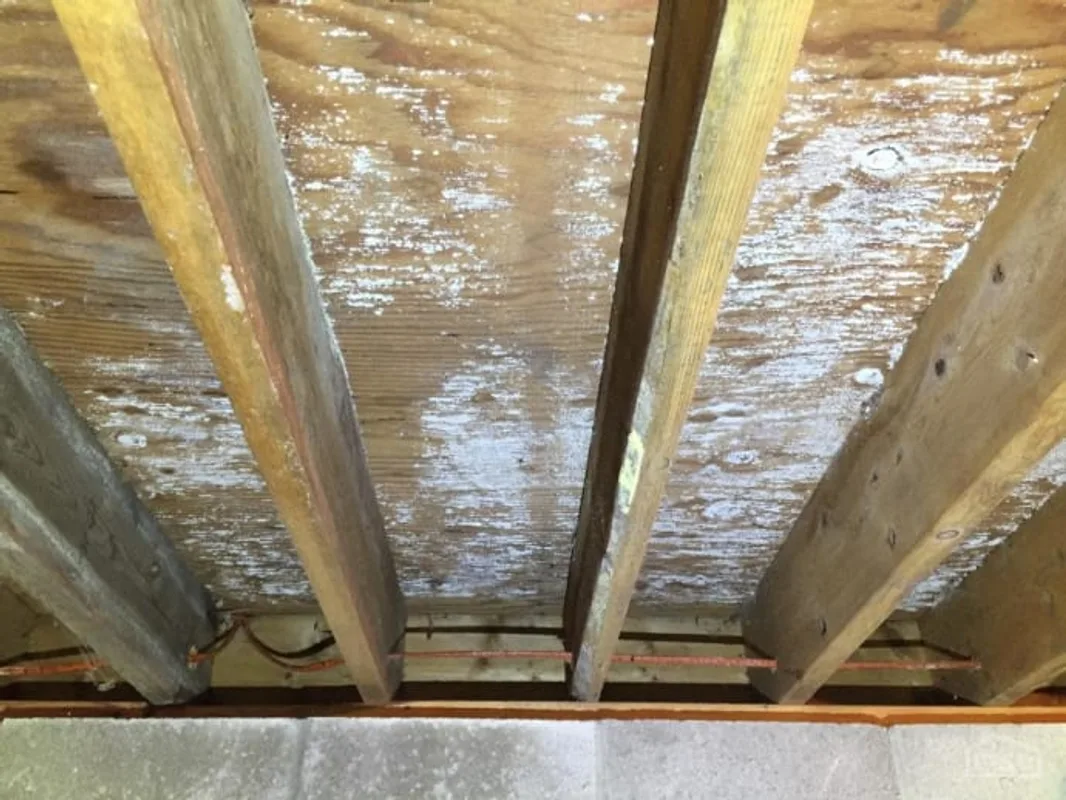
This is the stack effect at work: warm air from the living space exits through the top of the house, and crawl space air, carrying humidity, replaces it from below. If you’ve ever noticed that the first floor feels more humid than the second, or that there’s a persistent musty smell when the AC kicks on, crawl space moisture is usually part of the explanation.
A whole-house dehumidifier at the air handler can handle moisture from all sources, including what migrates up from below. But for homes where the crawl space itself is contributing heavily, pairing a crawl space dehumidifier with a whole-house unit is the more complete solution.
What a Whole-House Dehumidifier Does Differently
A whole-house dehumidifier integrates directly with your existing HVAC system at the air handler. It runs on its own humidity set point (separate from the thermostat), so when the AC is off but the indoor RH climbs past 50%, the dehumidifier cycles on to pull moisture out. It draws air from the return duct, removes moisture over its own refrigerant coil, and returns drier air to the supply side.
Triangle Dehumidifiers, LLC installs AprilAire whole-house dehumidifiers in homes across Wake County. The unit runs quietly alongside your existing system, drains to a condensate line, and is set once to maintain 45–50% RH and then left alone.
The installed cost runs an estimated $4,500–$5,500 for a standard air handler integration, or $5,000–$7,000 for systems that need additional ductwork or electrical. Those ranges depend on your home’s size, where your air handler is located, and how much access there is to drain. An inspection gives you an exact number.
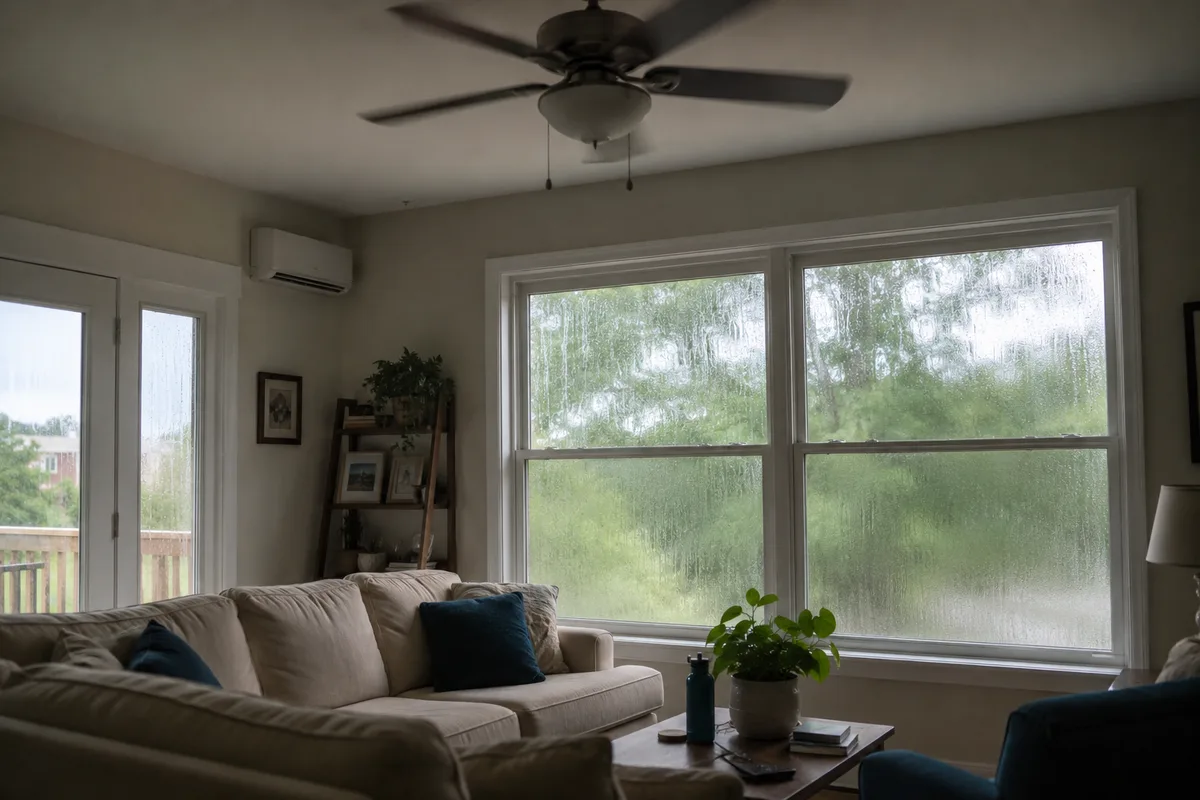
If you’re noticing signs your home has a humidity problem, such as condensation on windows, musty odors, wood floors cupping, or allergy symptoms that worsen indoors, the combination of summer outdoor humidity and insufficient dehumidification is worth addressing before it causes damage.
Warning Signs Your Home’s Humidity Is Out of Control
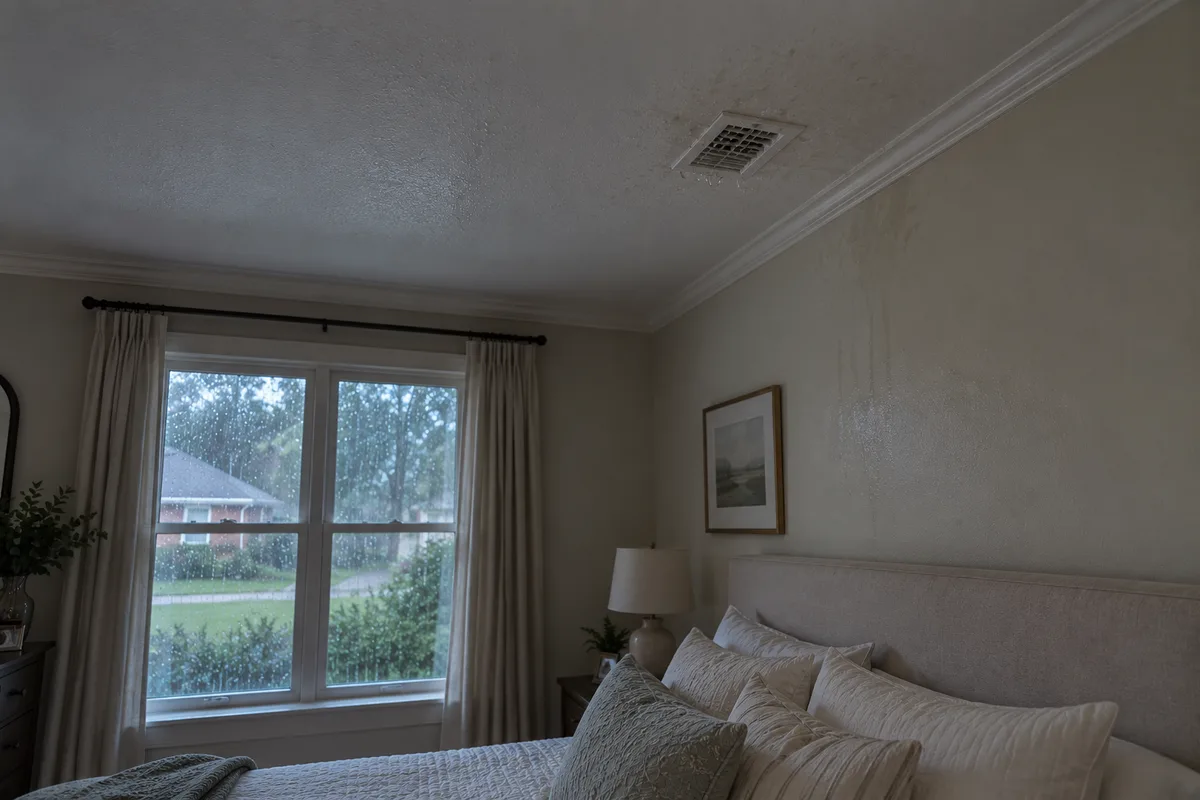
- Window glass fogs or sweats on the inside during summer (the indoor air is more humid than the glass surface)
- Musty smell when the AC kicks on for the first time each morning
- Wood floors feel slightly soft underfoot, or visible gaps close in summer as boards swell
- Allergy or asthma symptoms noticeably worse at home than outside
- RH reading above 55% on a hygrometer indoors, even with AC running
Two or more of these is a clear signal. An inspection will confirm what’s happening and give you an exact quote.
Frequently Asked Questions
Does a whole-house dehumidifier help even if my AC works fine?
Yes. A whole-house dehumidifier targets moisture directly, which is something a central AC system does only as a side effect of cooling. In a hot-humid climate like the Triangle's, AC alone rarely keeps indoor RH below 50–55% during peak summer. A dehumidifier integrated at the air handler runs independently of the thermostat and handles the latent load your AC can't catch.
What indoor humidity level should I keep my house at in summer?
The EPA recommends keeping indoor relative humidity between 30% and 50%. In the Triangle, most homes without supplemental dehumidification run 55–70% RH on summer afternoons, even with AC running. At 60% RH and above, mold can begin growing on surfaces within a few weeks. A target of 45–50% RH is realistic and comfortable for most Triangle homes.
How much does a whole-house dehumidifier cost in Raleigh?
A whole-house dehumidifier installed at your air handler in the Raleigh area typically runs $4,500–$5,500 for a standard integration, or $5,000–$7,000 if your HVAC setup requires additional ductwork or electrical. Triangle Dehumidifiers, LLC provides inspections and exact quotes for homes throughout Wake County and the Triangle.
Still Sticky Even With the AC Running?
If your house feels muggy every summer regardless of how long the AC runs, the fix isn’t a new thermostat or more AC. It’s managing the moisture load your AC was never designed to handle alone. Triangle Dehumidifiers, LLC in Holly Springs, NC installs whole-house dehumidifiers throughout Wake County and the Triangle region.
Triangle Dehumidifiers provides inspections throughout Wake County and the Triangle. We’ll check your current indoor RH, review your HVAC setup, and give you a written quote. No upsells, no scare tactics.
Call or text us at (919) 867-0580, or request your inspection online. We serve Raleigh, Cary, Apex, Holly Springs, Fuquay-Varina, Garner, Wake Forest, Knightdale, Morrisville, Durham, and Chapel Hill.